

Investment process
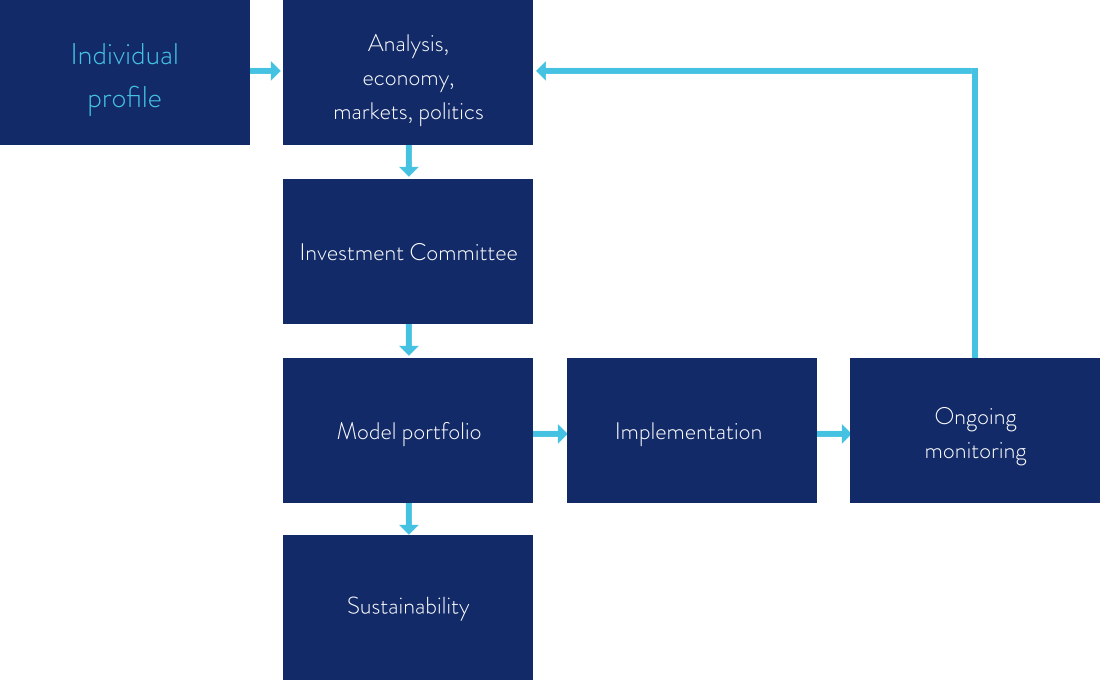
Individual profile
- We focus on your personal needs and goals.
- We work together to find the investment strategy that is best suited to your particular situation.
- Your liquidity requirements influence both the strategy that needs to be taken as well as the investment selection.
- In addition to bespoke and successful investment solutions, this process also results in lasting client relationships.
Analysis, economy, markets, politics
-
Politics
Political uncertainties are increasingly impacting global economic developments. We use leading indicators as part of our decision-making process enabling us to implement measures proactively. -
Economy
We process economic data on an ongoing basis, and link the results closely to our investment decisions. In addition to country-specific developments, local developments are also taken into account. - Markets Market and sector-specific developments and key indicators provide information about growth potential as well as trends. We deploy the results when selecting investments and when balancing opportunities and risks.
Investment Committee
- The Committee, consisting of experienced investment professionals, decides on the binding tactical asset allocation (TAA) for all investment profiles.
- Tactical decisions have a major impact on investment outcomes. The Committee decides primarily on the weighting per asset class and region.
- The decision-making process entails observing the overall investment policy environment on an ongoing basis as well as preparing forecasts on all relevant factors.
Model portfolio
- Implementation of the tactical decisions.
- Investment selection based on sector and industry prospects.
- Selection of actively or passively managed investment funds to cover special topics.
Implementation
- Implementing the investment decisions in your portfolio.
- Cost-effective realisation of allocation adjustments.
- Careful processing within the context of existing market prices and market depth.
Ongoing monitoring
- Your portfolio is monitored on a daily basis.
- We follow macroeconomic and economic policy developments closely, and use our short decision-making channels.
- Investments are compared with our expectations, assessed and checked for effectiveness within the portfolio context.
Sustainability
Livalor Asset Management Ltd exclusively provides asset management services. In line with the European Union’s approach, we understand sustainability not only in environmental terms, but across the entire ESG spectrum of environmental, social and governance factors. As a Liechtenstein asset management company, we are subject to the disclosure requirements of the EU Sustainable Finance Disclosure Regulation (Regulation (EU) 2019/2088, SFDR), which has been applicable in Liechtenstein since 1 May 2022.
Sustainability Risks
Sustainability risks are environmental, social or governance events or conditions whose occurrence could have a material adverse effect on the value of an investment. They are therefore taken into account irrespective of any sustainability preference expressed by the client:
- For all mandates, we exclude direct investments in companies operating in the gambling, weapons and pornography sectors.
- The assessment is based on a sustainability score derived from MSCI’s ESG rating and supplemented by ESG momentum, business practices, business activities and contributions to the United Nations Sustainable Development Goals.
There is no uniform definition of sustainability in asset management; assessments may therefore vary depending on the data and rating source used.
Sustainability Preferences
We assess the sustainability preferences of all clients as part of the investor profile. Clients may choose from four levels: sustainability-neutral, responsibility-oriented, sustainability-conscious and sustainability-oriented. The selected level is documented in an addendum to the Asset Management Agreement and includes binding minimum requirements for individual securities and the overall portfolio. At the “sustainability-neutral” level, we do not apply any specific sustainability preference requirements; however, sustainability risks continue to be taken into account.
Principal Adverse Impacts on Sustainability Factors
We currently do not publish a statement on the principal adverse impacts of investment decisions on sustainability factors. This is due to the size and resources of our company as well as the incomplete availability of reliable and comparable data, particularly outside Europe.
Remuneration Policy
Our remuneration policy is consistent with the integration of sustainability risks and does not provide incentives to disregard sustainability risks or to take inappropriate sustainability risks.
As at: 1 July 2026